
In the Future we will all be Mixed Bloods and Mestizos, 1995
Jaune Quick-to-See Smith
(1940-2025)
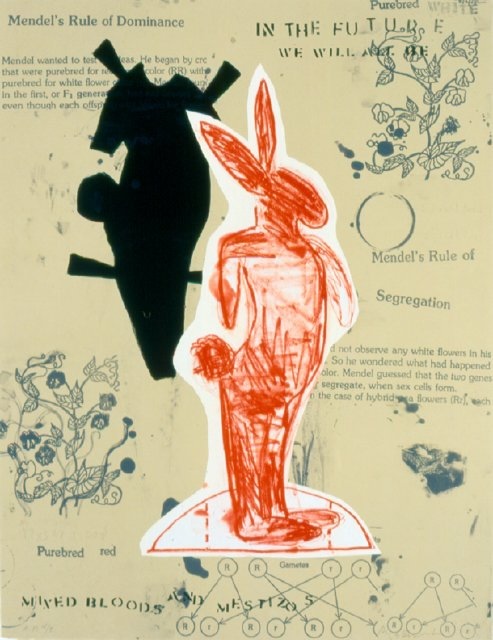
In the Future we will all be Mixed Bloods and Mestizos, 1995
Lithograph/Pastel/Chine Colle
On loan from the Missoula Art Museum
Quick-to-See Smith combines symbolic images and text to explore themes of identity and cultural intersections in her deeply thoughtful and often humorous art. Here she presents a rabbit in standing position, as found in an ancient petroglyph of a rabbit. The rabbit appears in the Cree creation story and is known as a trickster. The rabbit has flaps at his feet like a paper doll, and is superimposed over scientific illustrations and writing which describe aspects of a genetics theory brought forth in the 1860’s by Czechoslovakian monk and scientist, Gregor Mendel. A black silhouette which looks like it would fit onto the rabbit like a paper doll garment is shown in high contrast in the background of the image.
By including the word “segregation,” Smith plays with its many meanings. Mendel’s Theory of Segregation was intended as a scientific quest for a Universal Law and was created using green and yellow pea plants. Here Smith uses red and white for the botanical illustrations in her artwork. Mendel’s work with peas was all about genetics, and how dominant and recessive genes can show up in plant breeding over successive generations. Plants bred to maintain their original features are considered homogenous, where plants with mixed features are considered heterogeneous. Clearly, Smith is speaking to the genetic mixing of people of different tribes and races. For very different reasons, genetic purity is a topic of concern both for indigenous nations and white nationalists. Through juxtaposition and layering, Smith invites us to engage with the complexity of our perceptions and our relationship to controversial beliefs.
The rabbit is featured primarily because of its long-term presence in Western art and cultural iconography. Think Bugs Bunny, Playboy Bunny, Jeff Koons, Peter Rabbit, Easter Bunny…the list goes on. It also plays a significant role in Native American creation stories of the Cree, Ojibwe, and Chippewa tribes. The standing rabbit in particular is referenced world-wide as a “trickster” and is here to help Smith see through what she calls her “little spoof.”
Bio from the Missoula Art Museum
Jaune Quick-to-See Smith (Salish-Kootenai, Métis-Cree, Shoshone-Bannock) was born in St. Ignatius on the Confederated Salish and Kootenai Reservation. She was an enrolled member of the Flathead Nation, and descended from French, Cree, and Shoshone ancestors. She moved to New Mexico in the late 1970s, where she worked as an artist, teacher, lecturer, curator, and activist—or, as she describes, “a cultural arts worker.” Her creative voice and her powerful commitment to social, environmental, and political issues established her as a dominant figure in contemporary American art. Yet she continued to maintain vital connections to Montana and American Indian culture.
Art historian Carolyn Kastner wrote that Quick-to-See Smith’s art is “always contingent, conditional, and historical….Her own complex identity is the starting point, her target is the point of complexity in each
viewer, and her goal is to create a moment of recognition, agitation, and, finally, comprehension. Visualizing and representing cultural identity is not the end in itself, but rather her method of pointing to the problem of representation—how an artist expresses specific and differing perspectives on history, gender, and the notion of race to incite response and action.”